
Franklin Parole and Probation Defined
Parole is conditional release from the custodial part of a sentence. The sentence remains in force, and the person must follow the terms set by the proper authority. Probation is community supervision ordered by a court. It may be imposed instead of jail, after a jail term, or as part of a county case. Neither term means that the conviction or sentence has been erased. Franklin County residents may encounter either system, but the source of the sentence determines which office has the record.
A state prisoner released on parole is generally supervised by Pennsylvania Department of Corrections field staff. Franklin County Adult Probation/Parole handles people under the jurisdiction of the Franklin County Court of Common Pleas. Someone can leave Franklin County Jail on a county sentence without entering state parole. Likewise, a state parolee may live in Franklin County even though the county court did not impose that supervision. The release papers and sentencing docket settle the lane.
| Point | Parole | Probation |
|---|---|---|
| How it begins | Conditional release from a custodial sentence | Sentence or order issued by a court |
| Franklin record source | PA DOC locator, Board Action, and state field office | County docket, probation order, and Franklin office |
| Custody link | Follows a prison term | May exist with or without a prison release |
| How it ends | Formal discharge or sentence expiration | Court-authorized completion or discharge |
- Board Action
- The written Pennsylvania Parole Board decision for an individual case.
- Discharge
- The formal end of supervision, supported by an agency or court record.
- Absconder
- A person the supervising agency says has stopped reporting or cannot be located as required.
- Recommitment
- A return to custody after a parole violation decision.
Verify Franklin Post-Release Supervision
Begin with the last known custody and the sentencing court. The PA DOC Inmate/Department Supervised Individual Locator covers state inmates and Department-supervised people, not people held only by Franklin County Jail. Its supervised-person side can return a parole number, name, current location, release date, and identity fields. A missing result does not establish discharge. The locator is updated daily and is not promised as a full historic record after supervision ends.
- Read the sentence, release papers, or UJS docket to learn whether the case is a county-court matter or a state-prison parole.
- For state parole, search the PA DOC locator by parole number or name. Compare date of birth, county, and other fields before accepting a match.
- For county probation or county parole, use the sentencing docket and order, then confirm the reporting office shown on the paperwork with Franklin County Adult Probation/Parole.
- If a state parole decision matters, obtain the written Board Action from the person, counsel, or the Parole Board records channel.
- When no current tool resolves the status, ask for the formal discharge or sentence-expiration record from the agency that imposed or supervised the term.
The Commonwealth locator instructions explain its state scope and county-facility exclusion. That limit prevents a common error: treating a blank PA DOC result as proof that a person left Franklin County Jail or finished county probation.
Pennsylvania SAVIN powered by VINE adds a notice channel, but it does not replace the governing supervision record. Franklin County says its notices can concern bail, work release, parole, or escape. Those events have different meanings. A parole alert may mark a custody change without showing the assigned office or the later discharge date. Confirm the event with the jail, PA DOC, the court, or the office named in the release papers. A notification is timely context, while a Board Action or probation order states the legal basis.
The live interface below shows the separate inmate and Department-supervised search paths. Open the official PA DOC locator before relying on its current labels.
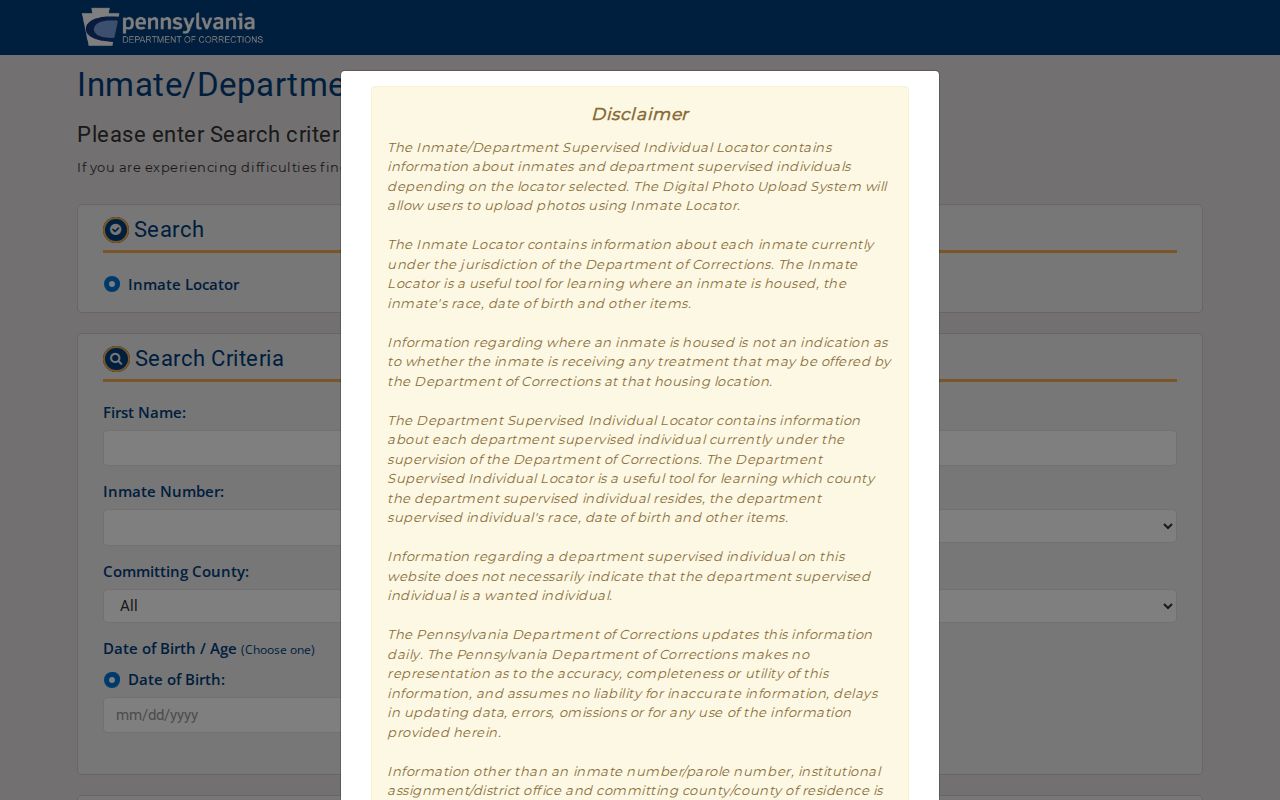
The split search makes the key distinction visible: state supervision records belong in the parolee lane, while Franklin County court supervision requires county records.
Note: A release date in the supervised-person results is not proof that every term of supervision has ended.
Franklin County Supervision Lanes
Calling the wrong office can yield a truthful no-record answer that is easy to misread. Franklin County Adult Probation/Parole supervises cases under the county Court of Common Pleas. State field offices supervise people paroled from PA DOC incarceration. The state provides reporting instructions before release, so the assigned office on those papers should control over a guess based only on the person's address.
Franklin County Adult Probation/Parole
440 Walker Road
Chambersburg, PA 17201-9798
717-264-6613
Use: county-court probation and parole supervision.
The county office page describes its court-based work, including community supervision and presentence reports. For state parole, use the PA DOC parole office directory only after the state record or release paperwork confirms that lane. The directory locates offices. It does not confirm a named person's status.
Franklin Parole Board Actions
The Pennsylvania Parole Board makes state parole decisions. Its public parole-process pages describe interviews and decision rules, but research found no official person-by-person hearing calendar and no searchable public database of individual results. The public Board meetings page concerns agency meetings, not a named inmate's interview date. The Board of Pardons is also different. Its clemency calendar must not be used as a parole calendar.
A named-person result arrives through a written Board Action. An original review may grant parole or refuse it. Violation proceedings can continue parole or order recommitment. Eligibility under Pennsylvania law is not a promise of release, and a grant can still be subject to conditions. “Parole to detainer” means another authority may receive the person, so even a favorable action may not prove physical release into the community.
Parole authority rests chiefly in 61 Pa.C.S. § 6137. The judicial minimum or an applicable RRRI minimum may establish when the Board can consider a case, but it does not create a right to be released. Life and death sentences are outside ordinary parole authority. Pennsylvania also uses distinct decision structures for some offense, RRRI, and Short Sentence Parole cases. Read the individual action instead of assigning an outcome from a meeting date or a general process page.
The official Board decision explanation shows where the written action fits in the process.
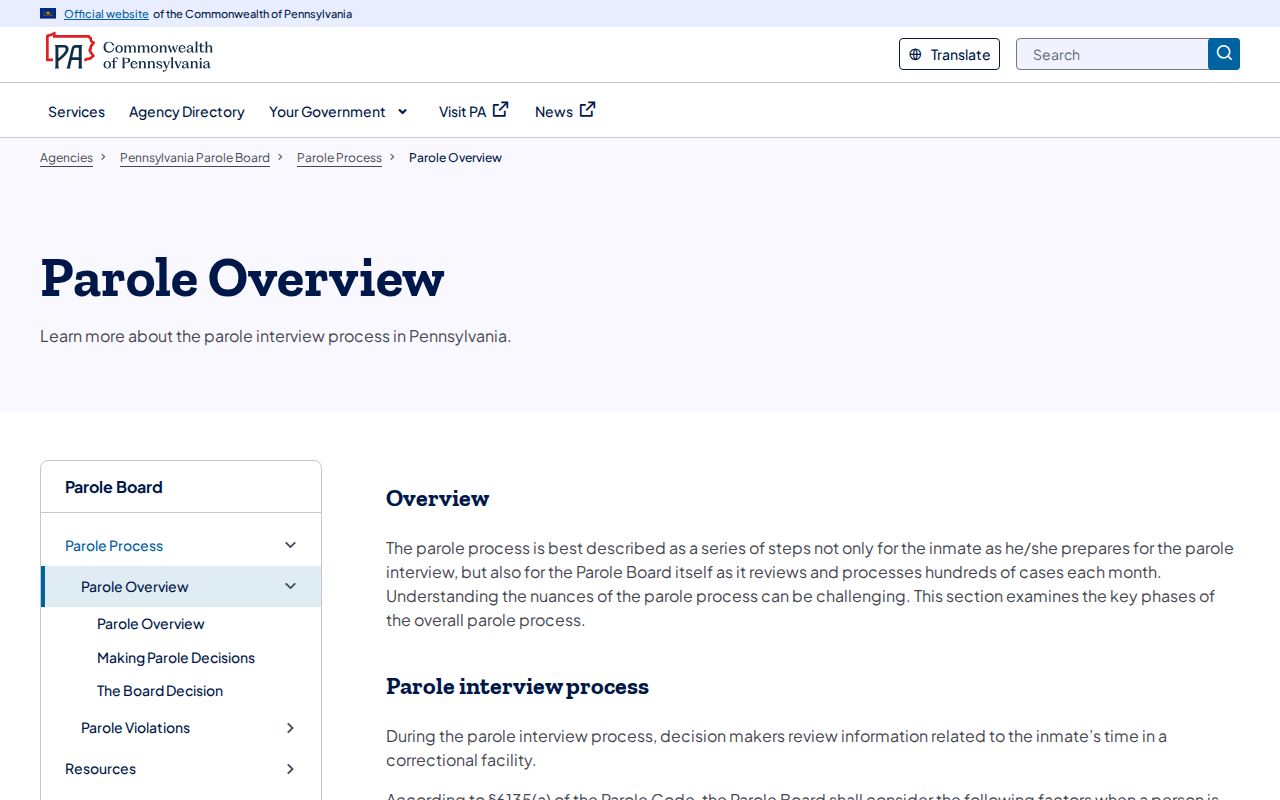
Use that decision with the facility movement record, because the legal decision and the physical custody change are separate events.
When the action is not available from the person or counsel, the Parole Board Right-to-Know channel accepts a request for an identifiable record as legally available. Address it to Janaki Theivakumaran, 1101 S. Front Street, Suite 5100, Harrisburg, PA 17104-2521, or RA-pbpprighttoknow@pa.gov. Published office hours are Monday through Friday, 9 a.m. to 5 p.m. Disclosure depends on the record and law.
Franklin Parole Absconder Warnings
PA DOC maintains a Most Wanted Absconders search with text and filter controls. County appears in its results, so a search can be narrowed to Franklin context. A match means the agency identifies that person as wanted in a supervision case. It does not show that the person completed parole, and it should not be treated as a routine release record.
No match proves nothing about release, compliance, or discharge. Records can change, and the search is a warning channel rather than a complete list of everyone on supervision. The official page says not to confront anyone. Tips go to 800-932-4857 or RA-CRabscondertips@pa.gov. For an immediate safety concern, use the proper emergency channel instead of attempting contact.
Note: Confirm ordinary supervision through the assigned office and governing order, not through the absconder list alone.
Ending Franklin County Supervision
Supervision ends through a formal act or the lawful expiration of the sentence. A person may stop appearing in a public locator for many reasons. That absence is not a discharge record. For state parole, seek the Board Action, PA DOC discharge documentation, or sentence record. For county probation, obtain the Franklin County court order or completion record and confirm it through the county office.
Violations can alter the path. A technical parole violation may lead to a Board Action that continues parole, recommits the person, or includes a reparole date under the applicable process. The word “discharge” should be reserved for a documented end of supervision. It should not be inferred from a change of address, a missed search result, or the end of jail custody.
The broader Franklin County released inmate search explains how to match the supervision record with the original jail, court, or state custody event. That comparison helps distinguish release from jail, transfer, parole, probation, and final discharge.
Franklin County Reentry Connections
Franklin County Jail describes Jail to Community Treatment among its transition services. The listed work includes substance-use assessment, counseling, and medication-assisted therapy. These are jail-based services, and the official material does not promise that every person qualifies or that help continues for a fixed span after release.
Franklin Together is a separate local reentry navigation contact at 533 S. Main Street, Chambersburg, PA 17201. The listed phone is 717-778-7758 and the email is reentry@sccap.org. Its role should not be confused with supervision. A reentry navigator may connect a person with community resources, while only the court, PA DOC, or assigned supervision office can confirm legal status and reporting duties.
The distinction is practical. Support services do not change a Board Action, probation order, warrant, or discharge date. A person should follow the written reporting instructions first and use the local network for navigation within its stated scope.