
Franklin County Release Dates Differ
“Projected,” “eligible,” and “released” answer separate questions. A forecast or computed date reflects the sentence and credits known at that point. A minimum date is usually the first ordinary point at which the Pennsylvania Parole Board may consider parole. It is not an appointment for release. A maximum date is the outer endpoint of the sentence calculation unless lawful credit, aggregation, a new court order, or another authority changes it. The actual release date is the date the holding facility records the movement.
A person awaiting trial at Franklin County Jail normally has no sentence-based projected release date. Bail may be posted, charges may be dismissed, or a judge may issue a new order. Each event can authorize release, yet staff still must complete physical processing. For a person serving a county sentence, the sentence order and jail calculation control. For a PA DOC prisoner, the state sentence and DOC computation control. A release from one agency may also be a transfer to another.
Find a Franklin County Release Date
Start by identifying the custodian. Franklin County Jail holds both accused people and some sentenced people, while PA DOC holds state-sentenced prisoners. The state locator excludes people held solely in county facilities. Searching the wrong system can produce a truthful no-result that says nothing about the person's actual release date.
- Determine whether the person is pretrial, serving a Franklin County sentence, or serving a Pennsylvania state sentence.
- Find the sentencing docket and order through the court. Read the minimum, maximum, consecutive, and concurrent terms as entered.
- For county custody, ask Franklin County Jail records how that order and any lawful credit were applied to the identified jail term.
- For state custody, use the PA DOC locator for present status, then request the DOC sentence computation or release record for controlling dates.
- Check for a Parole Board Action, program eligibility, a detainer, a modified sentence, or recommitment.
- Confirm the actual event with the holding facility rather than treating a forecast as completed release.
The Franklin County Clerk of Courts keeps Common Pleas criminal files and sentence-related court records. Magisterial District Judge records may cover the early case stage, while the Common Pleas file carries later disposition and sentencing. The jail remains the source for the physical end of a Franklin County custody episode. A court order explains authority, but it may not show the minute that jail processing ended.
For a named-person search that starts before the sentence lane is known, use the Franklin County released inmate search sequence to separate county, state, court, and receiving-agency records.
Note: A court order can authorize release before the jail finishes identification checks, paperwork, property return, and other required processing.
Franklin County Locator Labels Matter
The official PA DOC service is “Locate an Inmate or Parolee,” and the live tool is the Inmate/Department Supervised Individual Locator. Its inmate search accepts an inmate number or last name, with added fields for first and middle name, committing county, citizenship, gender, current location, and age or date of birth. The supervised-person side accepts a parole number or name and can display a field called “Release Date.”
The public interface sweep did not verify labels for “Projected Release Date,” “Tentative Release Date,” “Minimum Date,” or “Maximum Date.” The locator's “Release Date” field must not be renamed as a future projection. It can support a returned supervised-person record, but the sentencing order and a DOC record are the sound routes for minimum and maximum dates. The service also is not promised as a permanent archive after a person is fully discharged.
The PA DOC locator instructions explain the state-only scope and daily updates.
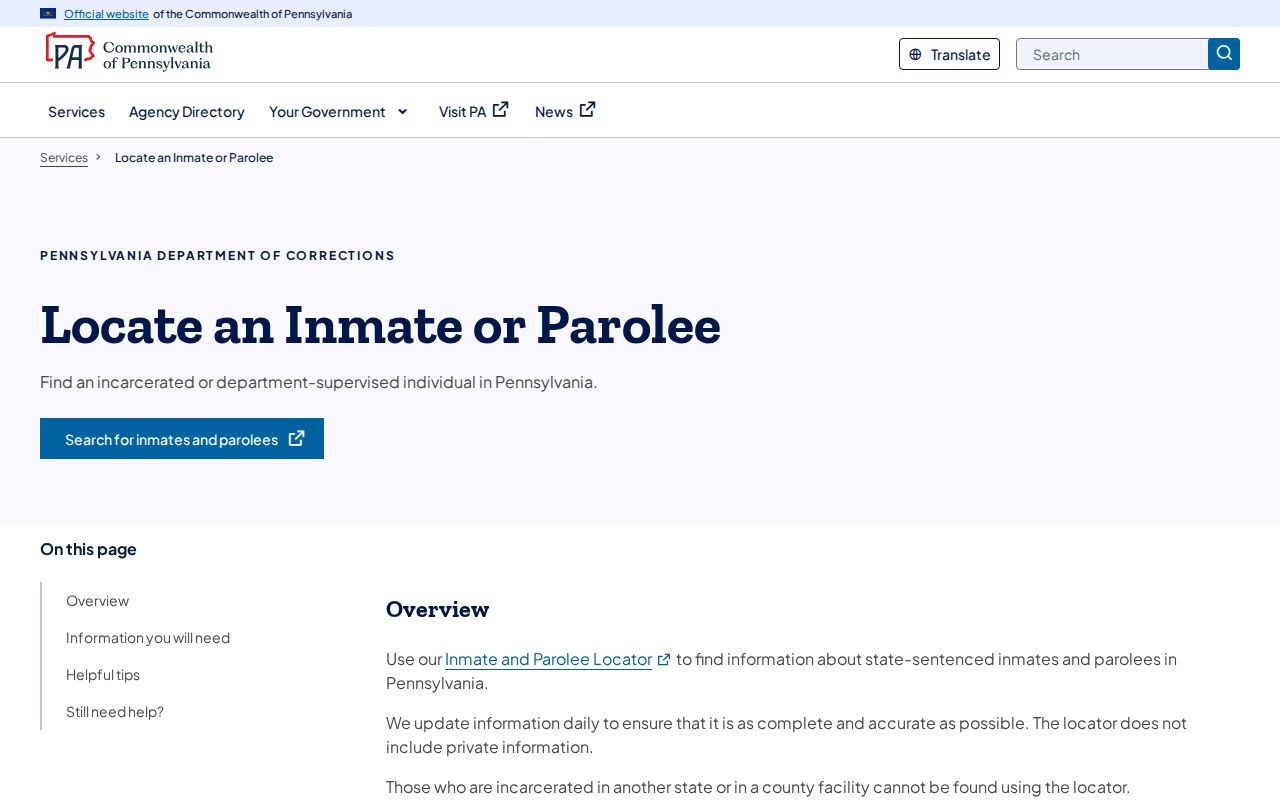
The official screen is useful for scope and present status, but it does not replace the court sentence or a DOC computation record.
Franklin County Sentences Use Two Dates
Pennsylvania generally uses indeterminate sentences with a judicial minimum and maximum. Under 42 Pa.C.S. § 9756, the minimum generally may not exceed one-half of the maximum, subject to statutory exceptions. A sentence of this kind does not yield one guaranteed exit date. It creates a span, and other laws govern what can happen within it.
| Date or event | What it means | What it does not prove |
|---|---|---|
| Judicial minimum | First ordinary parole-eligibility point for many state sentences. | It does not guarantee a parole grant or physical release. |
| Judicial maximum | Outer sentence endpoint used in the lawful calculation. | It may require adjustment for credits, aggregation, or later court action. |
| Board grant | Parole has been approved under stated terms and conditions. | It does not prove that all pre-release steps are complete. |
| Release to detainer | The person may move to another jurisdiction's authority. | It does not necessarily mean release to the community. |
| Actual release | The facility records the custody movement. | It does not always end parole or other supervision. |
Parole power is governed by 61 Pa.C.S. § 6137. The Board generally may consider an eligible prisoner after the judicial minimum or an applicable RRRI minimum. Life and death sentences are outside ordinary parole power. Discretion matters. Reaching the minimum lets a process occur; it does not compel the Board to release the person.
A county sentence stays in the county lane. PA DOC programs do not compute release from Franklin County Jail. Ask the Franklin County Jail how it applied the sentence order and credit to that case. Research found no public Franklin County policy that gives a universal formula for county-jail good time.
Franklin County RRRI Release Calculations
The Recidivism Risk Reduction Incentive, known as RRRI, is a distinct Pennsylvania program. It is not a general credit given to every prisoner. The court must impose an RRRI minimum for an eligible offender, the person must meet program and certification requirements, and the Parole Board must take the action required by law. Any one missing condition can block use of the reduced minimum.
Under 61 Pa.C.S. § 4505(c), the RRRI minimum is generally three-fourths of the minimum when the minimum sentence is three years or less. It is generally five-sixths when the minimum exceeds three years. Those fractions calculate an RRRI minimum, not automatic discharge. Eligibility exclusions, completion of required programming, DOC certification, and Board review still matter.
- RRRI minimum
- A reduced parole-eligibility point imposed for an eligible person under Chapter 45.
- Parole
- Conditional release from custody under supervision; the sentence continues.
- Discharge
- The formal end of the sentence or supervision, not merely a missing locator result.
- Detainer
- A hold or request tied to another case or jurisdiction that may change the release destination.
Motivational Boot Camp under Chapter 39 and Short Sentence Parole under § 6137.1 are separate programs. They have their own eligibility rules and exclusions. Neither should be mixed into an RRRI estimate. A Board Action and the DOC record show which path, if any, applies to the identified person.
Note: RRRI changes a possible parole point only when the legal, program, certification, and Board conditions all apply to that sentence.
No Universal Pennsylvania Release Shortcut
Pennsylvania has no verified blanket rule that every state prisoner must serve 85 percent of the sentence. That shorthand is often linked to the federal system and should not be imported into a Franklin County or PA DOC calculation. Pennsylvania research also found no universal day-for-day DOC credit that mechanically cuts every judicial maximum in half.
“Good time” can hide several different concepts. RRRI, Boot Camp, Short Sentence Parole, sentence credit, and ordinary discretionary parole arise from different legal sources. County-prison commutation law is separate again. Historical county law traces to the Act of May 11, 1901, P.L. 166, formerly 61 P.S. §§ 282 and 283, but amendments and exclusions require current legal review. No Franklin-specific public calculation policy was found.
The reliable method is case based. Obtain the sentence order. Identify all terms and whether they run at the same time or one after another. Ask the correct jail or DOC records office for its computation. Then check the Board Action or program record. A simple percentage cannot replace that work.
Franklin County Release Dates Can Change
A projected date is only as stable as the facts used to compute it. Sentence credits may be corrected. Multiple sentences may be aggregated, which means they are combined under the applicable rules. A judge may modify an order. Parole may be granted, refused, or later rescinded through lawful process. Program status may also change before the person reaches a possible release stage.
| Factor | Possible effect on the release path |
|---|---|
| Credit correction | Changes the time credited against the sentence and can move a computed date. |
| Consecutive or concurrent terms | Changes how several sentences are combined and which minimum or maximum controls. |
| Court modification | Alters the legal sentence or custody authority used by the jail or DOC. |
| Parole decision | A grant, refusal, rescission, or later recommitment changes the expected path. |
| Program eligibility | Loss or gain of a lawful program route can change an earlier estimate. |
| Misconduct | May affect program status or another decision without creating one universal penalty formula. |
| Detainer or hold | Can shift the destination from the community to another agency or jurisdiction. |
Recommitment is return to custody following a parole process or violation decision. It can lead to a new calculation and a later Board Action. A technical parole violator may receive an automatic reparole date in a Board Action, but that document and its conditions control. A web result should never be made to say more than the formal action.
Detainers Alter Franklin County Release Outcomes
A detainer can leave the date unchanged while changing the destination. “Parole to detainer” may mean that Pennsylvania releases the person from one form of custody into the authority of another jurisdiction. That is not the same as walking out to the community. The sending facility's release record and the receiving agency's record must be read together.
The same point applies at Franklin County Jail. A county custody episode can end through transfer to PA DOC, another county, a federal custodian, or immigration custody. Work release can also change a person's status while the person remains in the jail's Pre-Release Unit. The Franklin County Work Release Program requires court eligibility followed by a jail assessment. It is not unconditional discharge.
Ask a precise question: where did the person go when this agency's custody ended? A release date without a release disposition or receiving-agency field cannot answer that. If the source record identifies a transfer, continue with the named custodian before describing the person as out of custody.
Note: “Parole to detainer” can mark a real release from PA DOC custody while another jurisdiction immediately takes control.
Confirm a Franklin County Release Date
For a county case, compare the Common Pleas sentencing order with the Franklin County Jail calculation and movement record. Ask for the admission date, release date and time, release disposition, and destination or receiving agency if maintained. For a state case, identify the DOC number and request the sentence computation or release/discharge record through the PA DOC Right-to-Know channel. A specific request is more useful than asking an office to predict a date.
A Pennsylvania Parole Board Action is the key document for an individual parole decision. It may grant or refuse parole and can state conditions that must be met. The action still should be paired with the facility's movement record. Physical release may follow the decision, or another hold may change where the person goes.
VINELink can add a pending custody-change alert for participating county jail, state prison, and state parole records. The Franklin County VINELink check explains online and telephone registration. An alert helps with timing, but the agency record proves the event. Final discharge from supervision requires formal discharge or sentence expiration, not disappearance from a locator.